

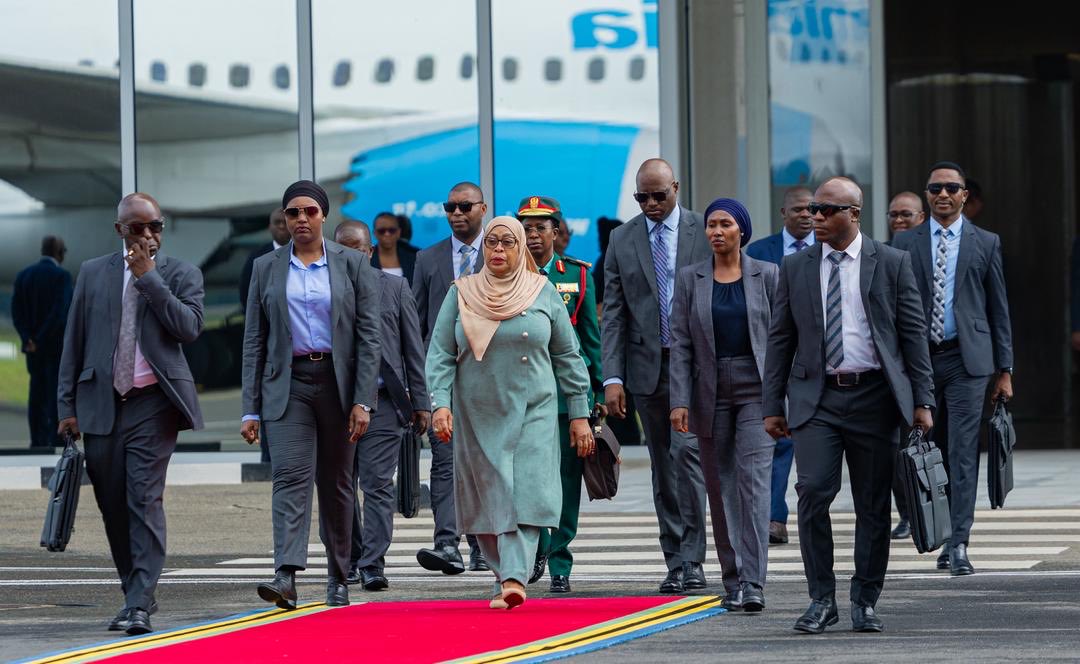
President Samia Suluhu Hassan’s visit to Russia is not just another diplomatic engagement. It is a strategic mission that places Tanzania at the center of emerging global opportunities and demonstrates the country’s growing influence in international affairs.
At a time when the world is becoming increasingly multipolar, Tanzania is refusing to be a spectator. Instead, it is actively building partnerships, expanding markets, attracting investment, and positioning itself as a serious economic player.
Here are ten reasons why President Samia’s Russia visit matters for Tanzania.
President Samia is making history
History matters in diplomacy.
President Samia becomes only the second Tanzanian Head of State to undertake an official visit to Russia since Mwalimu Julius Nyerere’s historic trip in October 1969, when the Father of the Nation visited Moscow and St. Petersburg during the Cold War era. Tanzania and the Soviet Union had established diplomatic relations just two days after Tanzania’s independence on December 9, 1961, making Russia one of the earliest partners of the newly independent nation.
More than five decades later — 57 years to be precise — Tanzania is reopening a high-level chapter in its relationship with one of the world’s major powers. President Samia’s three-day visit from June 3 to 5, 2026, comes at the personal invitation of President Vladimir Putin, and will include the conferral of an honorary doctorate (Honoris Causa) from the Peoples’ Friendship University of Russia (RUDN University) in recognition of her leadership and diplomatic contributions.
This alone makes the visit one of the most significant diplomatic engagements of recent years.
Tanzania is expanding its global influence
Strong nations do not isolate themselves.
President Samia’s presence in Russia demonstrates that Tanzania is increasingly becoming an important voice in international affairs. Tanzania’s economy is one of the strongest performers on the continent, growing at 6.0% in 2025 — well above Africa’s continental average of 4.4%. The IMF projects GDP growth of 6.3% in 2026, while the country’s GDP is estimated to reach approximately $452 billion (PPP) by the end of 2026.
From Washington to Beijing, from Brussels to New Delhi, and now Moscow, Tanzania is engaging major global centers of influence and ensuring its interests are represented wherever important decisions are being discussed. The country attracted a record USD 1.72 billion in foreign direct investment in 2024, a 28.3% increase over 2023 — the fastest FDI growth rate in East Africa.
Tanzania is securing new markets for its economy
Economic growth requires access to markets.
Russia represents a vast market for agricultural products, minerals, tourism services, and future Tanzanian exports. Bilateral trade between the two countries has already been growing rapidly, increasing nearly 20% in 2025 to exceed USD 200 million. Russia currently exports grain, fertilizers, equipment, and veterinary drugs to Tanzania, while Tanzania supplies tobacco, coffee, tea, and fruits.
Russian officials have estimated that the current trade volume has significant unrealized potential and could feasibly double in the near term as new commercial channels open. Russian enterprises have also expressed specific interest in Tanzania’s pharmaceutical market and livestock product supplies.
By strengthening relations with Moscow, Tanzania is widening its economic reach and reducing dependence on a limited number of trading partners. This is exactly how resilient economies are built.
Tanzania is positioning itself for more investment
The St. Petersburg International Economic Forum is one of the world’s leading investment platforms. SPIEF 2025 saw delegations from 144 countries, with 1,116 contracts signed worth over 6.5 trillion rubles. SPIEF 2026, running June 3–6, is expected to draw more than 24,000 participants from over 130 countries and territories.
President Samia arrives not as a visitor but as Tanzania’s chief investment ambassador. The Tanzania Investment Centre registered 842 projects worth USD 7.7 billion in 2024 — the highest investment value since 1991. The country has set a target to attract USD 15 billion in investments in 2025, prioritizing manufacturing, clean energy, transport, minerals, agriculture, and services.
The country enters the forum with enormous opportunities in energy, mining, infrastructure, manufacturing, logistics, agriculture, and tourism. A dedicated Tanzania-Russia Business and Investment Forum will bring together business leaders, investors, and investment promotion institutions from both countries. Every serious investor attending SPIEF will have the opportunity to see Tanzania as one of Africa’s most promising investment destinations.
Tanzania is accelerating its industrial investment
Industrialization remains one of Tanzania’s most important national goals. The Tanzania Development Vision 2050 (DIRA 2050), set to begin formal implementation on July 1, 2026, aims to propel the country into a USD 1 trillion economy with an average per capita income of USD 7,000. Industry currently contributes 28% to GDP, with the vision targeting 40% through strategic investments in industrial parks, export zones, and skills development.
Russia possesses advanced expertise in engineering, manufacturing, heavy industry, and industrial technologies. Deeper cooperation creates new pathways for industrial growth, technology transfer, skills development, and economic diversification. Tanzania’s 2025 minerals value addition report identifies 14 opportunities across 11 minerals worth USD 7.2–11.7 billion annually, with the potential to generate over USD 1 billion in tax revenue and 25,000 jobs through local processing.
This is precisely the type of partnership required to support Tanzania’s Vision 2050 ambitions.
Tanzania is strengthening its energy future
No country industrializes without reliable energy.
Russia is one of the world’s leading energy powers and possesses decades of experience in power generation, natural gas development, and energy infrastructure. Tanzania holds proven natural gas reserves of approximately 57.54 trillion cubic feet — making it the sixth largest natural gas holder in Africa — with about 70% of areas with potential oil and gas deposits still unexplored.
Tanzania’s installed electricity generation capacity reached 4,522 MW by March 2026, a 12.2% increase from 4,032 MW a year earlier. Electricity connectivity has risen from 37.7% in 2020 to 52.1%, with the government targeting 75% access by 2030 and 100% shortly after. The planned Tanzania LNG project, in partnership with Shell, Equinor, and ExxonMobil, is expected to produce 10 million tons of LNG per annum once operational.
As Tanzania seeks to maximize its natural gas potential and expand energy access, cooperation with Russia in this sector strengthens the foundation for future economic growth.
Tanzania is unlocking greater value from its natural wealth
The world is searching for critical minerals. Tanzania already possesses many of them.
Tanzania’s mining sector generated USD 4.1 billion in mineral exports in 2024, accounting for 25% of total exports and contributing 10.1% to GDP, with the sector expanding 9.8% in 2025. Gold remains the flagship commodity, with estimated reserves of 45 million ounces and sales reaching USD 4.6 billion in 2025.
Beyond gold, Tanzania holds an estimated 18 million tonnes of graphite reserves (6% of global reserves), with large-scale projects like the Mahenge and Epanko mines each expected to produce over 60,000 tonnes annually. The Ngualla Rare Earths Project is projected to yield 37,000 tonnes of REE metals per year. The Kabanga and Dutwa nickel projects add further depth to the country’s mineral portfolio.
Partnerships that support processing, technology, and value addition can help ensure that Tanzania benefits more from its natural wealth, rather than exporting raw materials at a fraction of their potential value.
Tanzania is investing in knowledge and innovation
Modern economies are built on ideas as much as resources.
Russia is already one of Tanzania’s most important education partners. In 2025, Russia led all countries in providing scholarships to Tanzanian students, offering 150 out of 260 total foreign scholarships. For the 2025–2026 academic year, Russia made 90 additional scholarships available across its leading universities, including RUDN University and Saint Petersburg State University.
In April 2026, a four-day educational exhibition titled “Russian Education — for Africa” was held across Tanzania, attracting 850 participants from both mainland Tanzania and Zanzibar, with a follow-up event planned for autumn 2026.
The discussions on education, science, research, and technology demonstrate Tanzania’s recognition that future prosperity will depend on innovation and human capital. Stronger academic and technological partnerships will help prepare Tanzania for the industries of tomorrow.
Tanzania is reinforcig its independent foreign policy
One of the strongest messages from this visit is that Tanzania remains committed to making its own decisions.
The country continues to maintain strong relations with the United States, China, Europe, India, the Gulf states, and African partners while simultaneously strengthening ties with Russia. China remains Tanzania’s largest investor, accounting for USD 11.4 billion (31%) of total FDI stock, followed by the United Kingdom (USD 5.66 billion, 15.4%), the United States (USD 4.75 billion, 13%), Mauritius (USD 4.09 billion, 11.2%), and India (USD 3.93 billion, 10.7%).
This is not about choosing sides. It is about choosing Tanzania. It is a foreign policy rooted in national interests, strategic flexibility, and sovereign decision-making — a tradition that traces back to Mwalimu Nyerere’s three pillars: total liberation of the African continent, African unity, and non-alignment.
Tanzania Is embracing the opportunities of a multipolar world Tanzania
The global order is changing. Economic and political influence is no longer concentrated in a single region or among a small group of countries.
President Samia’s visit reflects Tanzania’s understanding that success in the 21st century requires engagement with every major center of opportunity. Tanzania’s economy tells the story: tourism earnings reached USD 4.4 billion in 2025 with nearly 6 million visitors; mineral exports hit USD 4.1 billion in 2024; FDI reached a decade-high of USD 1.72 billion; and bilateral trade with Russia alone grew 20% in a single year.
Rather than waiting for change, Tanzania is positioning itself to benefit from it.
President Samia’s visit to Russia represents far more than diplomacy.
It is a statement of confidence. It is a statement of ambition. And it is a statement that Tanzania intends to engage the world from a position of strength.
From trade and investment to energy, education, technology, and industrialization, the visit reinforces Tanzania’s determination to build partnerships that advance national development and create opportunities for future generations.
Most importantly, it demonstrates a country that knows where it is going — and is increasingly confident about its place in the world.