

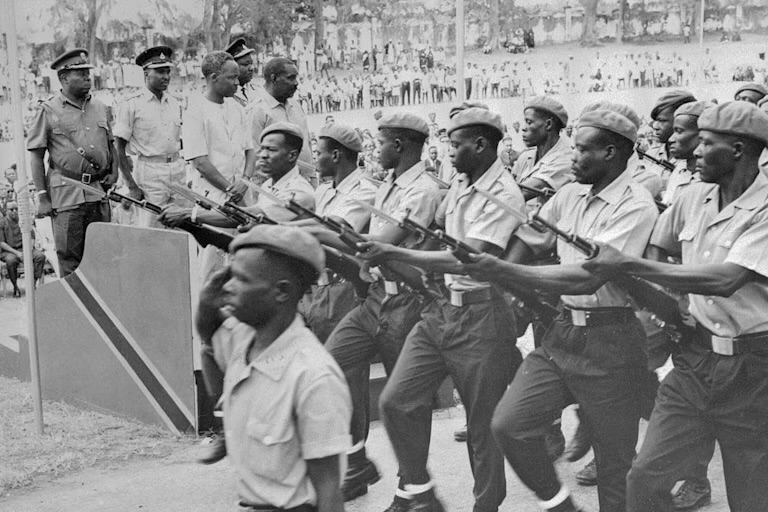
After independence, Julius Nyerere faced a major challenge: building a national army from scratch in a country with limited resources and a fragile security environment.
Rather than prioritizing a large military, he focused on creating a disciplined, politically aligned force that would serve both national stability and broader African liberation efforts.
The turning point came in 1964 following a mutiny within the colonial-era army. In response, Nyerere disbanded the old structure and established a new force—the Tanzania People’s Defence Force (TPDF).
Recruitment was centered on loyalty, national service, and ideological commitment, with many recruits drawn from youth movements and required to undergo national service training before joining.
Unlike many post-colonial armies, this new force was not designed for internal repression or elite control. Instead, it was built on principles of discipline, patriotism, and civilian oversight.
Nyerere was firm that the military should never dominate politics, insisting that “the gun must not replace the ballot,” reinforcing a culture of professionalism and restraint.
Beyond national defense, the army played a key regional role. Tanzania became a hub for African liberation movements, offering training, logistical support, and safe bases for groups fighting colonial and minority rule in southern Africa.
The military helped sustain these movements, positioning Tanzania as a frontline state in the struggle for independence across the continent.
Through this approach, Nyerere transformed the army into more than a security institution—it became a tool of political vision and continental solidarity. The result was a force that not only safeguarded Tanzania’s sovereignty but also contributed significantly to Africa’s broader liberation movements.