

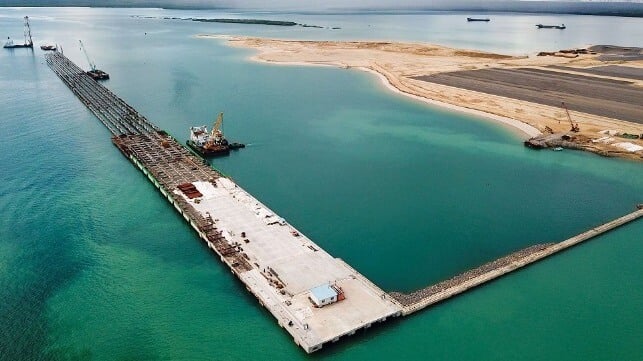
The global container-shipping reshuffle — accelerated by U.S.–China tensions and shifting trade routes — is now reshaping East Africa’s maritime map in real time. And in a surprising twist, Kenya’s long-struggling Lamu Port, once dismissed as a costly “white elephant,” is finally beginning to attract some of the world’s larger container vessels.
In the past few weeks, several major carriers have quietly added Lamu to their rotation, marking the port’s most significant activity since it was commissioned. The breakthrough moment came with the arrival of the Nagoya Express, the longest container ship ever to call at any East African port. At 335 meters and with an 8,604-TEU capacity, the Hapag-Lloyd vessel’s call signals a shift many thought would never materialize.
During its stop, the Nagoya Express picked up 140 transshipment containers bound for New York — cargo that had been offloaded two weeks earlier by MV Tolten, another Hapag-Lloyd Post-Panamax ship. According to the Kenya Ports Authority (KPA), this confirms that Lamu’s deep-water berths and wide turning basin were engineered for ultra-large vessels that Mombasa simply cannot handle due to its limited turning radius.
Since 2021, Lamu has been chronically underutilized, with fewer than 200 vessel calls recorded by late last year. For a multi-billion-shilling project meant to transform Kenya’s logistics capacity, the silence was deafening. That narrative is now shifting. KPA has confirmed that two CMA CGM vessels are scheduled to dock in the coming days — a sign that shipping lines are finally testing Lamu’s potential as a transshipment point on the Indian Ocean.
Still, Lamu’s challenges remain enormous. As the anchor of the LAPSSET Corridor, the port’s success hinges on inland infrastructure — roads, rail links, customs facilities — that remain incomplete. Without reliable connections to Ethiopia, South Sudan and northern Kenya, Lamu cannot yet compete for the bulk of regional cargo.
To revive momentum, the Kenyan government has signaled openness to leasing the port to a private operator capable of developing the remaining 20 berths and accelerating investment. Currently, only three berths are operational, limiting throughput and economies of scale.
Even so, the recent arrival of large boxships suggests that shipping lines are beginning to see value in Lamu’s natural depth, low congestion, and ability to host vessels that Mombasa cannot accommodate. These early movements do not erase the port’s long struggles, but they do mark the first real signs that Lamu may yet find a role in East Africa’s rapidly evolving maritime landscape.
Whether this is the start of a true turnaround or just a temporary spike remains to be seen — but for the first time in years, Kenya’s “white elephant” port is finally showing signs of life.