

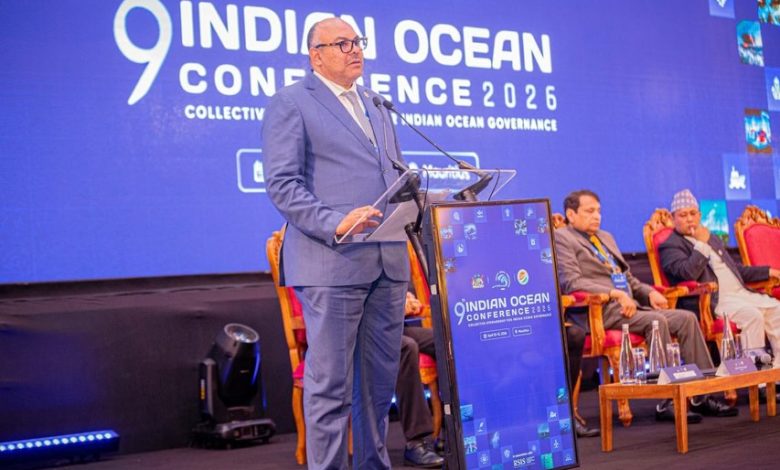
Tanzania took a firm and prominent stance on ocean governance this week, calling on Indian Ocean nations to unite in defending one of the world’s most strategically and ecologically important bodies of water. The call came during the 9th Indian Ocean Conference, held from April 10 to 12, 2026, in Port Louis, Mauritius — a gathering that brought together heads of state, ministers, and regional stakeholders to chart a collective course for the Indian Ocean’s future.
Tanzania’s voice at the conference was clear and urgent: protecting the Indian Ocean is not a matter of individual national interest, but a shared regional obligation that demands immediate, coordinated action.
Tanzania’s Call for Collective Stewardship
Speaking at the conference, Tanzania’s Minister for Foreign Affairs and East African Cooperation, Ambassador Mahmoud Thabit Kombo, delivered a passionate address underscoring the Indian Ocean’s critical role not just for Tanzania, but for all landlocked and coastal nations that depend on it for trade, food security, and economic survival. He warned that the ocean faces mounting threats — from geopolitical rivalries and maritime security incidents, to accelerating environmental degradation — and that no single country can confront these challenges alone.
Ambassador Kombo reaffirmed Tanzania’s ongoing commitments at home, pointing to the country’s investments in conservation, community-led environmental programs, and efforts to strengthen security within its own territorial waters. But he made clear that domestic action must be matched by regional solidarity. Every Indian Ocean nation, he argued, must accept its part in the shared responsibility of protecting these waters for generations to come.
The Indian Ocean: Tanzania’s Economic Gateway
For Tanzania, the stakes could not be higher. Ambassador Kombo described the Indian Ocean as a vital economic lifeline — not only for Tanzania’s own coastal communities but also as a critical trade corridor for landlocked neighbouring countries accessing global markets. Tanzania’s strategic position along the East African coast, combined with major investments in port development and energy infrastructure, is steadily transforming the country into a regional hub for maritime trade and transport services serving East and Central Africa.
The blue economy featured prominently in Tanzania’s submission at the conference. Ambassador Kombo highlighted that ocean-based sectors — including fisheries, maritime transport, coastal tourism, and offshore trade — collectively support millions of livelihoods across the country. Nurturing and protecting these sectors is therefore inseparable from Tanzania’s broader national development agenda. Any deterioration in the health or security of the Indian Ocean, he cautioned, would be felt most acutely by the very communities whose survival depends on it.
Bilateral Gains: Tanzania and Mauritius Deepen Ties
On the sidelines of the conference, Ambassador Kombo held productive bilateral talks with Mauritius’ Minister for Foreign Affairs, Regional Integration and International Trade, Mr Dhananjay Ramful. The two ministers reviewed the existing relationship between Tanzania and Mauritius — one built on mutual respect and aligned strategic interests — and identified new areas for deeper collaboration, particularly in trade and blue economy development. With Mauritian investment in Tanzania growing steadily alongside bilateral trade volumes, both sides expressed optimism about the direction of the partnership.
A Timely Message for the Region
Tanzania’s message from Port Louis arrives at a time when the Indian Ocean is increasingly a theatre of geopolitical competition, climate vulnerability, and resource pressure. By stepping forward as an advocate for collective stewardship and sustainable maritime governance, Tanzania — under the direction of President Samia Suluhu Hassan’s administration — is staking a claim as a responsible and forward-thinking voice in regional and global affairs.
The 9th Indian Ocean Conference has once again demonstrated that Tanzania is not merely a passive participant in the affairs of the Indian Ocean rim — it is an active, principled champion for the protection and sustainable use of one of the planet’s most vital maritime regions.