
A dramatic confrontation between the United States government and its own technology sector is raising a profound global question: Is America — long seen as the guardian of democracy — quietly transforming into a system where state power overrides freedom?
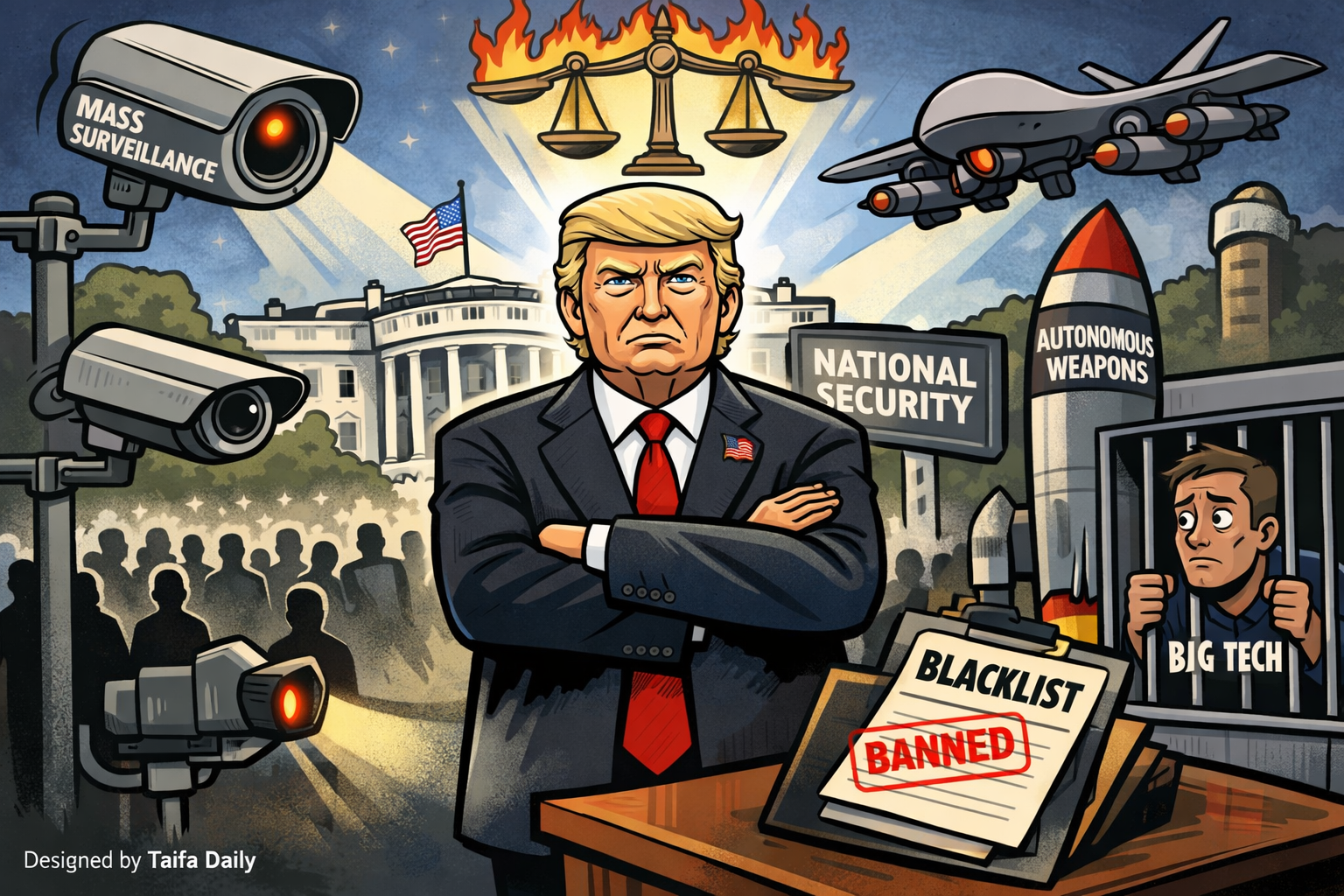
The controversy follows a decision by President Donald Trump’s administration to designate American artificial intelligence company Anthropic as a “supply chain risk,” a label traditionally used against foreign adversaries. The move came after the company refused to allow its AI technology to be used for mass domestic surveillance of American citizens and fully autonomous weapons.
For many observers worldwide, the incident signals something deeper than a policy disagreement. It reflects what critics describe as the emergence of a “silent dictatorship” — a system where control expands gradually under the banner of national security.
Punishing dissent in the name of security
Anthropic stated it resisted government pressure to enable large-scale surveillance and autonomous warfare, arguing such uses could violate fundamental rights and endanger public safety. The government’s response — treating the company itself as a national threat, has shocked many in the global technology community.
The implications are stark. A private American company that refused state demands now faces punitive action from its own government.
Such measures raise troubling questions about the limits of power in modern America. Can corporations operate independently of the state? Can civil liberties survive in an environment where refusal to cooperate with security agencies invites retaliation?
Critics warn that when governments punish non-compliance rather than debate policy, democracy begins to weaken.
Freedom or managed democracy?
The United States has historically portrayed itself as the world’s leading defender of individual liberty, free markets, and constitutional rights. Yet this episode presents a striking contradiction.
The company at the center of the dispute claims it was pressured to enable mass monitoring of citizens — a practice Washington frequently criticizes when conducted by other governments. Its resistance and subsequent blacklisting now challenge America’s global image.
Analysts say the situation exposes a growing tension within the American system: democracy in principle, centralized control in practice.
If national security becomes the ultimate justification for expanding state authority, some ask whether freedom remains unconditional — or simply permitted within boundaries defined by the state.
Mirroring the methods of rivals
The controversy also highlights an uncomfortable geopolitical reality: the world’s major powers increasingly behave in similar ways.
Practices often associated with China’s technological control, Russia’s security-first governance, or Iran’s strict state oversight — including surveillance capabilities, restrictions on private firms, and strategic control of technology — are now appearing within the American policy framework.
What Washington once described as authoritarian behavior is increasingly justified at home as necessary for national defense.
For critics, this convergence suggests that global competition is reshaping governance everywhere, blurring the distinction between democratic and authoritarian systems.
America’s double standard
The development also raises questions about the United States’ moral authority on the global stage.
For decades, Washington has lectured developing nations on governance, civil liberties, and human rights standards. Yet its own actions now reveal a willingness to expand surveillance power, discipline private institutions, and prioritize state control when strategic interests are at stake.
This perceived double standard is closely watched across Africa, Asia, and the Global South, where leaders have long argued that all nations — regardless of ideology — ultimately defend their sovereignty first.
The lesson emerging for many countries is clear: global power politics operates by the same rules everywhere.
Implications for Africa and the world
For Africa, the episode reinforces the urgency of technological independence and national sovereignty. As global powers compete over artificial intelligence and digital infrastructure, developing nations face increasing pressure to align with competing systems of control and influence.
It also challenges long-standing assumptions about governance models. If even the world’s most influential democracy expands state power in the name of security, the global conversation about political systems may be entering a new phase.
The future international order may be shaped less by ideological differences and more by competition for technological dominance.
A turning point in Global Democracy
The dispute between Washington and Anthropic may ultimately prove to be a defining moment in how the world understands American democracy.
Is this a temporary security measure in an era of rapid technological change? Or does it represent a deeper shift toward centralized authority within the United States?
What is undeniable is that the global image of America as the unquestioned champion of freedom is facing unprecedented scrutiny.
And for many observers, the concern is no longer whether power can reshape democracy, but whether it already has.