

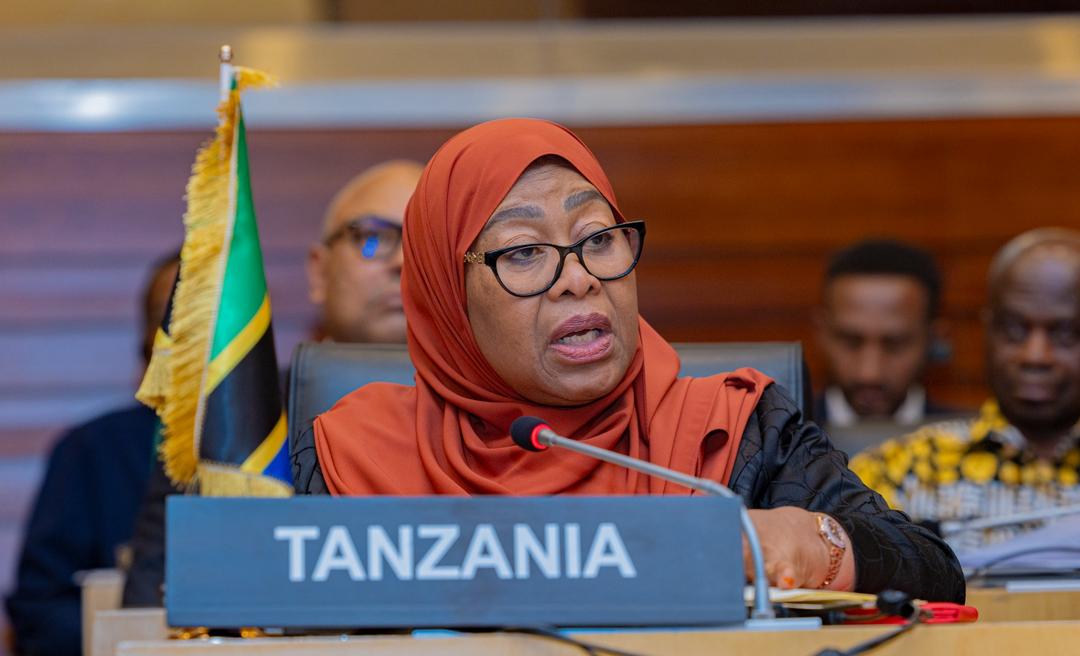
Samia Suluhu Hassan is betting a $79 billion economy on gas, graphite and geopolitical non-alignment. The numbers, so far, are on her side.
When Samia Suluhu Hassan stood up at Chamwino State House in January 2026 and told a room of diplomats and investors that Tanzania wanted “trade, not just aid,” it landed as the kind of line African presidents have been delivering for forty years.
The difference this time is the balance sheet behind it.
Tanzania closed 2025 with GDP growth of 5.9%, headline inflation at 3.3%, inside the central bank’s 3-5% target band, and 927 registered investment projects worth a combined $11.09 billion, enough to underwrite roughly 162,000 jobs. Exports in the year to June 2026 hit $19.9 billion, up 17.2%. Public debt sits at 40.6% of GDP, comfortably under the 55% sustainability threshold. Official projections put growth at 6.3% this year and 6.5% in 2027.
That is not a country negotiating from weakness.
The doctrine
Hassan calls the framework “Sovereign Pragmatism.” Stripped of the diplomatic packaging, it is a straightforward arbitrage play: stay formally non-aligned, engage everyone, and let Western concessional finance and Eastern infrastructure capital compete for the same projects.
The 2025 FDI table shows what that looks like in practice. Tanzania’s top five sources of foreign capital were the UAE, China, India, Singapore and France — a lineup with no obvious ideological through-line, which is exactly the point. Inflows reached $1.72 billion in 2024, a 28.3% jump.
The second pillar is value addition. Hassan’s government has spent two years trying to stop Tanzania exporting rocks and importing finished goods made from those same rocks. Buzwagi has been designated a mineral value-addition hub. The Ministry of Minerals is pushing geophysical survey coverage from 16% of the country to 34% by the end of this fiscal year — unglamorous, but it is the precondition for everything else.
What’s actually working
Mining is the standout. Sector exports rose 31.1% to $5.4 billion in 2025, with gold alone up 39% to $4.75 billion. Mining now accounts for 11.9% of GDP.
The critical-minerals build-out is further along than most outside investors realize. Between July 2025 and March 2026, Tanzania’s Mining Commission issued 454 licences for lithium, graphite, cobalt, nickel, rare earths and niobium, 271 of them for graphite, a market the World Bank and the US Geological Survey have both flagged Tanzania as a future major supplier in. In March, Dodoma signed a development agreement for the Panda Hill niobium project in Mbeya, which the government projects will deliver around TZS 2 trillion in returns and 1,600 direct jobs, and put Tanzania inside the global top four producers. Lifezone Metals’ $942 million Kabanga nickel project is targeting a final investment decision this year.
Power and logistics have moved too. The 2,115 MW Julius Nyerere hydropower plant, the largest dam in East Africa, reached full operation in April 2025. The Kwala dry port and the Kigongo-Busisi bridge both came online. Tourism pulled in $4.3 billion on an 11.4% rise in arrivals. Reserves stand at $6.3 billion, or 4.9 months of import cover.
What isn’t
The $42 billion LNG project remains the great unclosed trade. Negotiations with Shell and Equinor over 57 trillion cubic feet of offshore gas have run for the better part of a decade. The government is targeting a final investment decision in 2026, but as of mid-year neither the host government agreement nor FID has been signed. Until one is, Sovereign Pragmatism is a doctrine with a hole in the middle of it.
Then there is the political ledger. Hassan won October’s election with 97.66% of the vote after opposition figures were excluded from the ballot; the aftermath brought internet blackouts and a security crackdown in which opposition parties say hundreds were killed, and Washington imposed partial travel restrictions on January 1. Her response has been to commission an independent inquiry, stand up a reconciliation body, pardon 1,787 people convicted over the October 29 unrest, and open a constitutional rewrite. Whether that satisfies investors underwriting 20-year gas concessions is an open question, and one the capital markets have not fully priced.
The long bet
The frame for all of it is Dira 2050, launched this year, which targets a $1 trillion economy by mid-century and casts Tanzania as the logistics spine of both the EAC and SADC. It requires sustained double-digit growth. Tanzania has never done that.
But it has 70 million people, 42.8% of them under 15, a port system that serves six landlocked neighbours, and the minerals the energy transition cannot happen without. Hassan’s wager is that she can convert that into leverage rather than dependency.
Two years in, the macro numbers say she is not wrong yet. The unresolved question — the one the growth rate does not answer — is whether any of it reaches the wage-earner. Nominal GDP grew 37.5% between 2020 and 2025. Urban wages rose 5.3%.